The 2-Serving Lie: What Backpacking Meal Labels Hide
We put 284 freeze-dried meals from 14 brands into one spreadsheet. The "servings" printed on the pouch are quietly doubling what you think you pay per calorie - and the price for the same 1,000 calories swings nearly 4x.

Affiliate disclosure: this page contains affiliate links. If you buy through one, FoodEverest may earn a commission at no extra cost to you, whether through the Amazon Associates Program or another brand's affiliate program. Full disclosure.
across 14 brands
that eat as one meal
same 1,000 calories
a 7-day trip
Pick up almost any freeze-dried backpacking dinner and the back of the pouch will tell you it is 2 servings. Cook it at camp after a 20-mile day and it is one dinner - yours. That small piece of packaging fiction quietly reshapes the two numbers you actually shop on: the calories and the price.
So we stopped guessing and built a database. 284 freeze-dried and dehydrated meals from 14 brands, every figure taken straight off the manufacturer's own nutrition label - calories, net food weight, protein and price. Here is what the labels are not telling you.
1. The "serving size" is written for the label, not for you
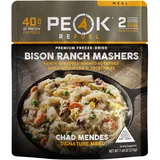
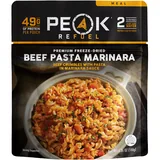
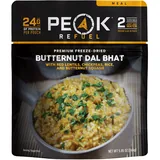
Of the 125 meals in our data that publish a serving count, 39 (31%) call themselves two servings or more. The habit is most common at Peak Refuel and Trailtopia, where a two-serving label is close to standard. On paper that halves every per-serving number on the pack. In a tent, nobody splits the pouch.
Read the pack honestly and every per-serving figure doubles: the calories, the price, and the sodium. Sodium is the one that quietly stings - it is listed per serving too, so the pouch you actually eat carries roughly double the number on the label's serving line.
2. You can pay nearly 3.9x more for the same calories
Once you compare on cost per 1,000 calories - the honest unit, since a calorie is the thing you are buying to fuel the walk - the market splits wide open. Across the 124 main meals in our data with a US price, the cheapest energy costs $12.43 per 1,000 calories and the priciest $48.35. Same job, 3.9x the money.
The expensive end is not buying you more dinner - often it is buying you a smaller pouch with a nicer story. The value end is where the calories-per-dollar actually live.
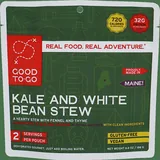
For the most calories per dollar among mains we have a US price for, Good To-Go Kale and White Bean Stew leads at just $12.43 per 1,000 calories (720 kcal for $8.95). See every Good To-Go meal in our Good To-Go data guide.
Best value main meals, ranked by cost per 1,000 calories
| # | Meal | $/1,000 kcal | Price | Calories |
|---|---|---|---|---|
| 1 | $12.43 | $8.95 | 720 | |
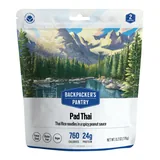
| 2 | $13.14 | $9.99 | 760 | |
| 3 | $14.28 | $15.99 | 1120 | |
| 4 | $14.41 | $14.99 | 1040 | |
| 5 | $15.23 | $12.49 | 820 | |
| 6 | $15.28 | $12.99 | 850 | |
| 7 | $16.08 | $13.99 | 870 | |
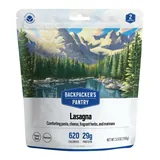
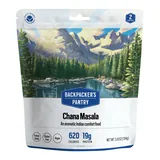
| 8 | $16.11 | $9.99 | 620 | |
| 9 | $16.11 | $9.99 | 620 | |
| 10 | $16.20 | $11.99 | 740 |
3. And the cheap calories can carry a weight penalty
Price is only half of value on the trail - the other half is what you carry. Calorie density in our data runs from 2.9 to 6.5 calories per gram. Over a 7-day trip at 3,000 kcal a day, the least dense choices mean hauling about 4 kg (9 lb) more food for the exact same energy. The best-value pouch is not always the lightest, which is why we track both.
Among main meals, Expedition Foods 5 Bean Cassoulet is one of the densest at 5.9 kcal/g, while Campers Pantry Indian Chicken Pilaf (XL) sits near the bottom at 2.9. We rank the full field in the most calorie-dense meals guide, and you can build a whole trip against your own weight target in the trip planner.
How we did this
Every number here is computed from our database of 284 freeze-dried and dehydrated meals across 14 brands, captured 2026-07-28. Calories, protein and servings come from each brand's published nutrition label; net weight is the brand's stated net food weight, never the padded shipping figure. Cost-per-calorie figures use brand-direct US MSRP only - we exclude currency-converted estimates so a price gap never reflects an exchange rate. Prices were captured 2026-07-28 and are not live; we link to brand and retailer pages so you can confirm the current number before buying.
Found a number that changed how you pack? Send it on.